The popphoto.com site as of writing still accepts subscriptions and is publishing new web articles, such as this one on the COOPH rope strap for Leica cameras.
Keep an eye on this unfolding story.
The popphoto.com site as of writing still accepts subscriptions and is publishing new web articles, such as this one on the COOPH rope strap for Leica cameras.
Keep an eye on this unfolding story.

Lomography gushes that the film has "a wonderfully unique aesthetic with traces of the distinctive X-Pro look. What’s more, it produces beautiful blue tones in certain shooting conditions, making it perfect for experimenting!" At this price, well worth experimenting with and getting a unique look.
The past year has been great for film aficionados, with the new Ferrania P30 Alpha, Japan Camera Hunter Street Pan 400, and more.
Around the web, see also Vincent Moschetti's review on Petapixel of Kodak Ektar 100 for landscape photography. Vincent has some nice pics of Ireland on this film.
Started in Rome, Italy by ars-imago international, the project hopes to release the LAB-BOX to the world by September, 2017. The company consists of two stores, one near the Vatican in Rome and one in Switzerland, serving film photographers.
Basic cost for one film loading module and the tank is now €79 for the Early Bird reward with one tank of your choice. The campaign is in fact fully funded at over €160,000 of the €70,000 goal. Rewards are going quickly, but the campaign is not over until March 28, 2017.
The unit seems simple to operate and can be used without a darkroom. The film adapter is first attached to the tank, then the film placed into the adapter and the cover placed on the assembly. All in subdued room lighting, not a darkroom. The film is then loaded onto the reel in the tank and processing chemistry is poured in over the top cover. The tank is drained through the front edge of the top, the corner of the tank itself forming a small spout to cleanly pour out.
The tank is ideal to use with a Monobath developer, a single step developer that includes the fixer. With a monobath, B&W film can be developed less than 10 minutes at room temperature. For those who wish, one of the rewards includes the tank, B&W film (your choice of format) and a monobath developer marketed by the company. Another alternative, is a caffenol developer packaged with the tank.
As with any Kickstarter, the more complexity the greater the risk.
The goal is to get a rougly 100 page, soft cover zine on matt paper featuring silver halide photography with four featured artists. His reasoning is that film photography looks best on paper, so he wants to bring that to fruition. This is not his first foray into zine-land, the premium Phoblographer offering is La Noir Image, an online e-zine that features B&W film photography. At $15 a year, the e-zine is not too expensive, but gets them experience publishing beyond the blog format. Certainly, it is tough to keep publishing regularly day, but these guys have pulled it off so far.
Funding for the project is due February 22, so support his campaign soon if you would like to see a magazine about film photography!
Check out these recent links to Phoblographer articles on film photography:
* Dedicated film camera repairman
* Make a film negative from Fujifilm FP-100C pack film
* Quick comparison of Tri-X to JCH Street Pan 400
* Introducing Bergger Pancro 400 B&W film
* Kodak explains why underexposed film gets a green tint
* Four modern analog film photographers to inspire
* Change.org petition to bring back Kodak Infrared Ektachrome
* Japan Camera Hunter to bring Street Pan 400 to 120 format
* She Shoots Film, a magazine on women photographers
* Adox announces construction of a new factory for film production
* Story of a video ad shot with a Nikon F5 film camera, 36 shots at a time
* Ilford animation on how a film SLR works
* Building a 4x5 film camera
Whew! Those are just the analogue photography links! Support your community, vote with your dollars!
The scan of the film shown in that update brought many to ask for access to that film. And so P30 was launched, a classic emulsion with a lineage dating back to a 1960s emulsion made by Ferrania of the same name, with a cinema pedigree, ultrafine grain, and very high silver content. The project hopes that with this ALPHA introduction of the film, much like an alpha release of software, will allow feedback from photographers and rapid improvements to the film and the process of making the film.
While the initial roll of film showed various defects, it is hoped that when the film is released in mid-Februrary, that most of the defects seen (such as bubbles formed on the emulsion during coating, scratches, dust, etc) will be greatly reduced or eliminated.
The film is ISO 80 will be available by mid-month in 35mm format.

The Kickstarter is fully funded, and will end on January 31, 2017. Like all Kickstarters, there is risk, so buyer beware.
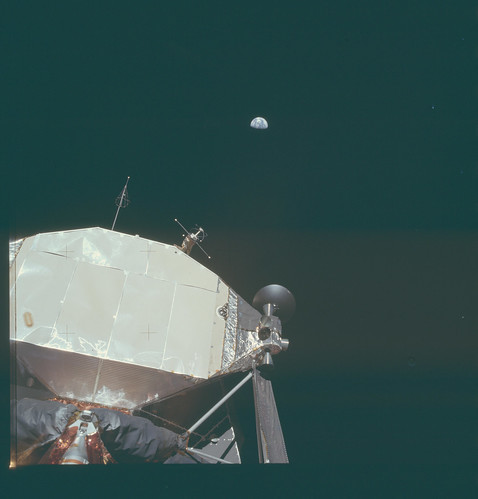
"Each film magazine would typically yield 160 color and 200 black and white pictures on special film. Kodak was asked by NASA to develop thin new films with special emulsions. On Apollo 8, three magazines were loaded with 70 mm wide, perforated Kodak Panatomic-X fine-grained, 80 ASA, b/w film, two with Kodak Ektachrome SO-168, one with Kodak Ektachrome SO-121, and one with super light-sensitive Kodak 2485, 16,000 ASA film. There were 1100 color, black and white, and filtered photographs returned from the Apollo 8 mission." -- NASA
The project started in 2009, on the 40th anniversary of the Apollo missions. The film had been stored for 40 years in freezers at zero Fahrenheit (-18 Celsius). After carefully bringing the film to room temperature, a Leica scanner was used to obtain 5 micron level of detail (around 5,080 ppi).
Browsing the photos on Flickr are much lower resolution, but the high resolution scans are available for downloading or sharing. LIke almost all works by the US Federal government, as enshrined in the Constitution, the photos are public domain.
A nice shot of home from the lunar base: